Best Fiber Supplements: What a Dose Actually Delivers
Last updated: September 6, 2026
Psyllium husk powder is the best fiber supplement for most people, and the numbers on the labels say why. Across the 15 current product labels compared below, one teaspoon of Konsyl Daily Psyllium Fiber delivers 5 grams of fiber, 3 of them soluble, while three capsules of the same brand’s psyllium deliver 1.1 grams.
That gap is the whole story of this category. Fiber supplements are sold by brand and by format, but they are bought for a number, and the number on the panel is rarely the number in the marketing.
The short version. Psyllium powder for regularity and cholesterol. Methylcellulose if fiber gives you gas. Wheat dextrin and inulin only to raise your daily total, not to fix constipation. Capsules and gummies for convenience, knowing you are paying more per gram.
No brand here paid to appear, and this page carries no affiliate links. Every product number comes from that product’s own Supplement Facts panel as filed with the National Institutes of Health Dietary Supplement Label Database, read in September 2026. Every clinical number is cited to the paper or regulation it comes from, listed in full on our sources page.
What one labeled dose actually gives you
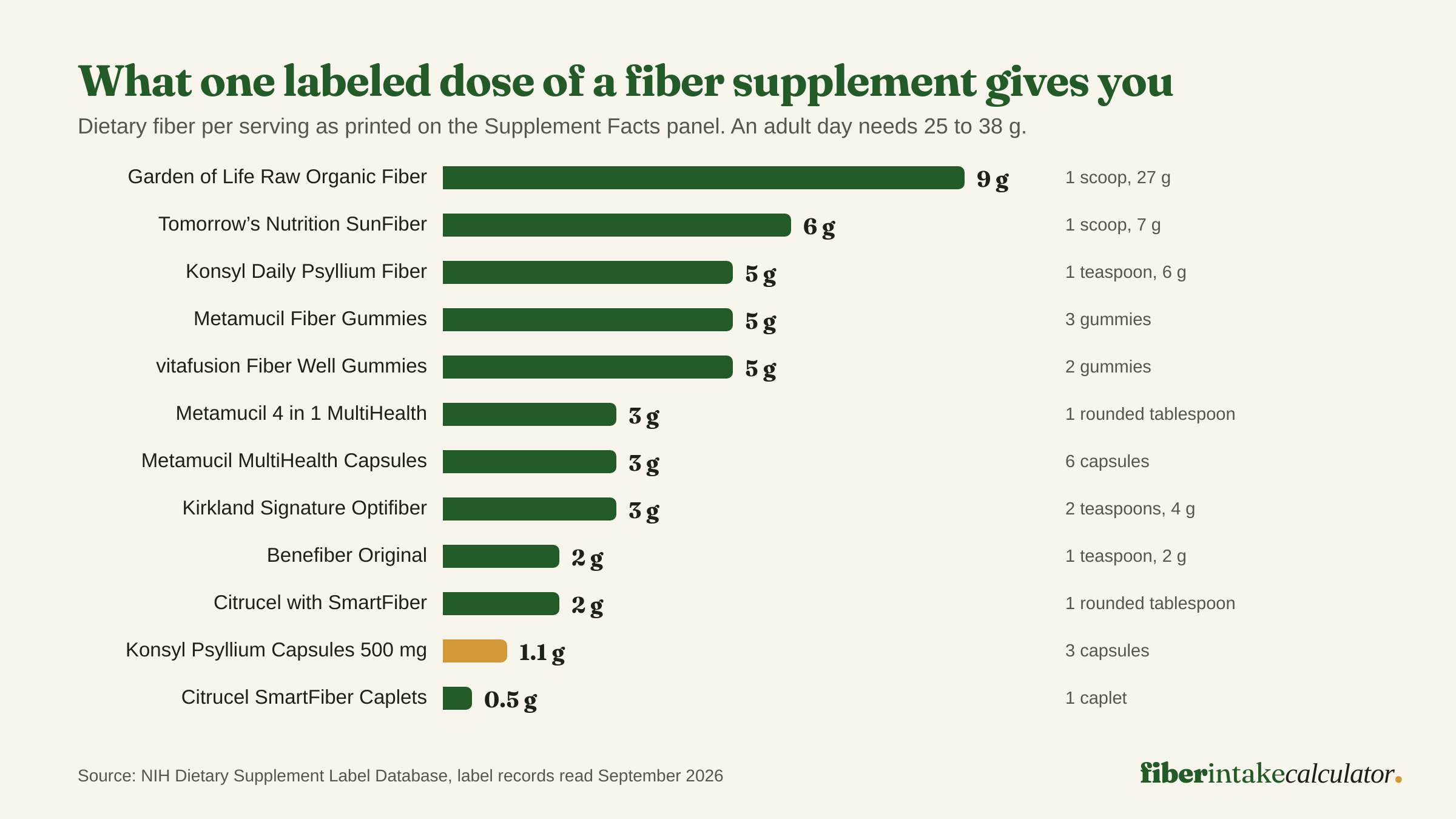
A labeled dose ranges from 0.5 grams to 9 grams of fiber. Adults need 25 to 38 grams a day under the Institute of Medicine reference intakes, so even the largest single dose here covers about a third of a day. Get your own number from the fiber calculator before you shop, because the size of your gap decides which format is worth the money.
| Product | Form | Fiber source | Labeled dose | Fiber | Soluble | Fiber per container |
|---|---|---|---|---|---|---|
| Konsyl Daily Psyllium Fiber | Powder | Psyllium husk | 1 tsp (6 g) | 5 g | 3 g | 335 g |
| Metamucil 4 in 1 MultiHealth | Powder | Psyllium husk | 1 rounded tbsp (12 g) | 3 g | 2 g | 145 g |
| Metamucil Psyllium Super Fiber | Powder | Psyllium husk | 1 rounded tsp (5.8 g) | 3 g | 2 g | 340 g |
| Metamucil MultiHealth Capsules | Capsule | Psyllium husk | 6 capsules | 3 g | 2 g | 80 g |
| Konsyl Psyllium Capsules 500 mg | Capsule | Psyllium husk | 3 capsules | 1.1 g | 1 g | 75 g |
| Citrucel with SmartFiber | Powder | Methylcellulose | 1 rounded tbsp | 2 g | 2 g | not listed |
| Citrucel SmartFiber Caplets | Caplet | Methylcellulose | 1 caplet | 0.5 g | 0.5 g | not listed |
| Benefiber Original | Powder | Wheat dextrin | 1 tsp (2 g) | 2 g | 2 g | 500 g |
| Benefiber Prebiotic chewables | Tablet | Wheat dextrin | 1.5 tablets | 2 g | 2 g | 135 g |
| Kirkland Signature Optifiber | Powder | Wheat dextrin | 2 tsp (4 g) | 3 g | 3 g | 570 g |
| Tomorrow's Nutrition SunFiber | Powder | Guar gum (PHGG) | 1 scoop (7 g) | 6 g | not listed | 180 g |
| Metamucil Fiber Gummies | Gummy | Inulin, corn fiber | 3 gummies | 5 g | not listed | 120 g |
| vitafusion Fiber Well Gummies | Gummy | Polydextrose, chicory | 2 gummies | 5 g | 5 g | 225 g |
| NOW Prebiotic Inulin Fiber | Capsule | Inulin, FOS | 3 capsules | 2 g | not listed | 120 g |
| Garden of Life Raw Organic Fiber | Powder | Seed and sprout blend | 1 scoop (27 g) | 9 g | 4 g | 90 g |
Two columns deserve a note. “Labeled dose” is the smallest serving the panel puts a fiber value against, which is what most people take. “Fiber per container” is the package net contents divided by the dose size, times the fiber in that dose, rounded to the nearest 5 grams.
Why psyllium is the default pick
Fiber works on your gut through physics, not chemistry, and only some fibers have the right physics. A 2017 review in the Journal of the Academy of Nutrition and Dietetics sorted the evidence by mechanism: cholesterol lowering and blood-sugar control track with viscosity, so gel-forming fibers such as beta-glucan, psyllium and raw guar gum deliver them, while non-viscous soluble fibers such as inulin and wheat dextrin do not.
A laxative effect needs a second property. The fiber has to reach the far end of the colon still intact, which means resisting fermentation. Psyllium does both. It gels, and it survives.
The clinical record matches. A 2022 meta-analysis in the American Journal of Clinical Nutrition pooled 16 randomized trials covering 1,251 adults with chronic constipation. 66% of people responded to fiber against 41% on control (risk ratio 1.48). Psyllium and pectin were the two fibers with significant effects, and the benefit showed up mainly above 10 grams a day, taken for four weeks or longer.
That last clause is the part people skip. Ten grams a day is two teaspoons of Konsyl powder or 20 Metamucil capsules, every day, for a month, before you judge whether it worked.
The capsule problem: 21 capsules to match a spoonful
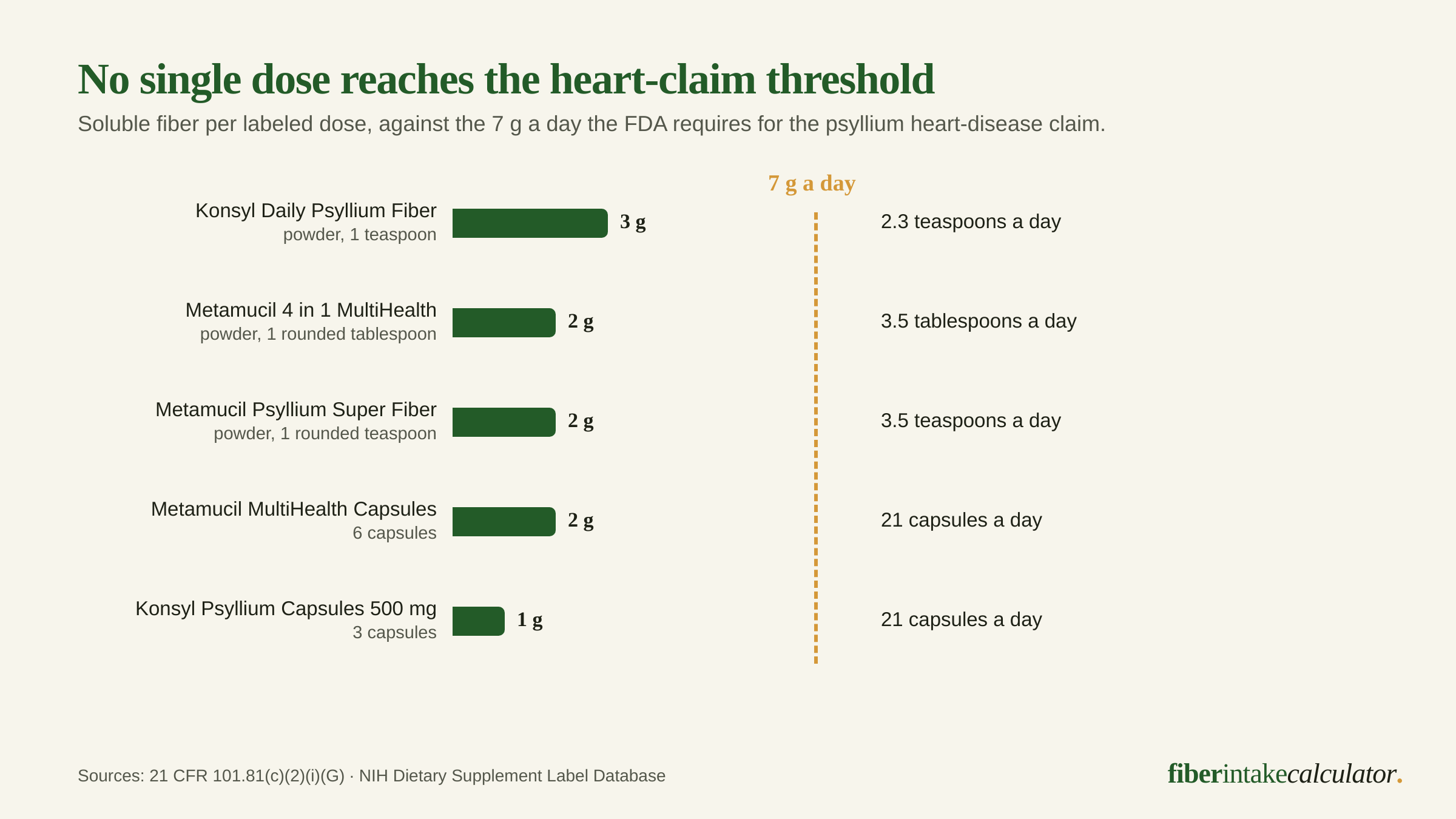
For heart health there is a hard regulatory number. Under 21 CFR 101.81, a product may tie itself to reduced coronary heart disease risk only in the context of a diet supplying 7 grams or more per day of soluble fiber from psyllium seed husk (the equivalent threshold for oat and barley beta-glucan is 3 grams).
Now do the arithmetic on the labels. Konsyl’s powder gets you there in 2.3 teaspoons. Metamucil’s Psyllium Super Fiber takes 3.5 teaspoons. Both psyllium capsule products take 21 capsules a day.
Worse, neither capsule product permits that. Konsyl’s capsule label caps you at three servings, which is nine capsules and 3 grams of soluble fiber. You cannot reach the FDA threshold on capsules without exceeding the directions on the bottle.
Grams of psyllium are not grams of fiber. Konsyl's capsule panel is unusually honest about this: 1.5 grams of psyllium husk powder yields 1.1 grams of dietary fiber and 1.0 gram of soluble fiber. When a label or an article quotes "6 grams of psyllium", expect roughly three quarters of that as fiber.
Capsules are not useless. They travel, they have no taste, and for someone whose only alternative is skipping the supplement entirely they are the right answer. Just price them honestly: the 160-capsule Metamucil bottle holds about 80 grams of fiber, against 340 grams in a canister of the same brand’s powder.
Psyllium or methylcellulose: which one you want
Methylcellulose, sold as Citrucel, is fully soluble and completely non-fermentable. Gut bacteria cannot eat it, so it produces essentially no gas. That is its entire selling point and it is a real one.
What it gives up is viscosity. Methylcellulose does not form the thick gel psyllium does, so it is not the fiber to pick for cholesterol. Its dose is also small: 2 grams per rounded tablespoon of powder, 0.5 grams per caplet.
| Fiber | Gel-forming | Fermented | Expected gas | Best at |
|---|---|---|---|---|
| Psyllium husk | Yes, strongly | Largely resists | Moderate | Regularity, stool form, cholesterol |
| Methylcellulose | No | No | Very low | Adding bulk when other fibers bloat you |
| Guar gum (PHGG) | Partly | Yes, slowly | Low | Sensitive guts, mixing into liquids |
| Wheat dextrin | No | Yes, rapidly | Moderate | Raising your daily fiber total |
| Inulin and FOS | No | Yes, rapidly | High | Feeding gut bacteria |
The gel-forming column is the one that predicts cholesterol and blood-sugar effects; the fermentation column predicts both gas and whether the fiber will still be there to soften stool. Both readings come from the 2017 mechanism review.
The fibers that will not do what the box implies
This is where the category gets uncomfortable. Wheat dextrin (Benefiber, Kirkland Optifiber) and inulin are the easiest fibers to swallow: tasteless, dissolve clear, mix into coffee. They are also, per the 2017 review, rapidly fermented, which means they provide no laxative effect at all, and the review notes wheat dextrin can even be constipating.
They are not frauds. They genuinely add grams to your daily total, and inulin genuinely feeds gut bacteria. If your goal is the number on our high-fiber foods chart or a prebiotic effect, they work. If your goal is a better morning, they are the wrong purchase.
Gummies are the sharpest case. Metamucil’s Fiber Gummies contain no psyllium. The label lists inulin and soluble corn fiber. A shopper reaching for the trusted psyllium brand in gummy form gets a different fiber that does a different job.
Best fiber supplement by goal
| Your goal | Pick | Why, and at what dose |
|---|---|---|
| Constipation | Psyllium powder | One of two fibers with significant effects in the 2022 meta-analysis. Aim above 10 g a day for at least four weeks. |
| Lowering LDL cholesterol | Psyllium powder | The only supplement fiber with an FDA heart-disease claim. Threshold is 7 g a day of soluble fiber, so 2 to 4 spoonfuls. |
| Loose stools | Psyllium powder | The same gel that softens hard stool absorbs excess water in loose stool. Start low. |
| Fiber gives you gas | Methylcellulose | Non-fermentable, so bacteria cannot turn it into gas. Accept a smaller dose per serving. |
| Sensitive gut or IBS | PHGG (guar gum) | Ferments slowly rather than rapidly, dissolves clear. SunFiber lists 6 g per 7 g scoop. |
| Just raising your daily total | Wheat dextrin | Cheapest per gram and the easiest to drink. Expect no effect on regularity. |
| Eating fewer calories | Food first | Fiber-dense food beats a supplement on a deficit. See fiber for weight loss. |
None of these replace food. Only about 5% of the US population meets fiber recommendations, and a supplement closes a gap rather than building the base. One cup of cooked lentils carries 15.6 grams, more than any single dose in the table above.
What a container is really worth
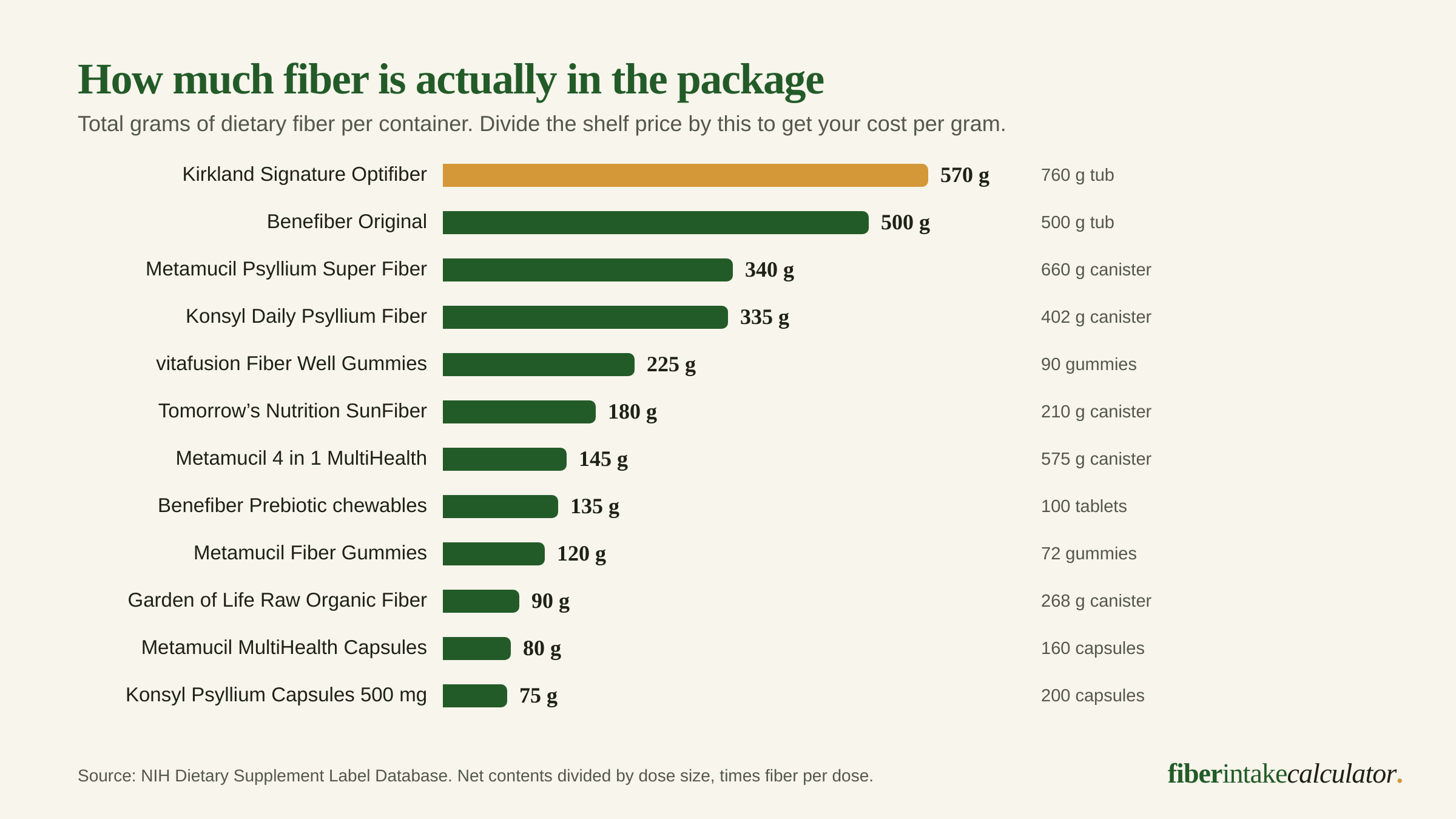
Prices move week to week, so quoting them would age this page badly. The stable number is how much fiber the package holds. Divide the shelf price by that figure and you have a cost per gram you can compare across formats.
The spread is larger than the price tags suggest. A tub of Kirkland Optifiber holds about 570 grams of fiber; a bottle of 200 Konsyl psyllium capsules holds about 75. That is roughly a sevenfold difference in what you are buying, before you compare stickers.
Read that alongside the fiber type, not instead of it. The cheapest gram in the chart is wheat dextrin, which is also the fiber least likely to do what most buyers want.
How to start without the gas
The 2022 meta-analysis found flatulence was significantly higher on fiber than on control, so treat side effects as expected rather than as a sign the product is wrong.
Start at roughly a quarter of the labeled dose. Add a little every four or five days. Take each dose with a full glass of water, since gel-forming fibers need water to work and can feel like a brick without it. Give the full dose four weeks before judging it, which is the minimum duration the trials used.
Space doses away from medications by two hours or so; a viscous gel slows absorption of whatever is in the gut with it. If constipation is new, severe, or comes with bleeding or weight loss, that is a reason to see a clinician rather than to try a different powder.
For the food side of the same problem, our soluble fiber table shows which foods carry the gel-forming fiber psyllium is standing in for, and our methodology explains how the daily targets on this site are derived.
Frequently asked questions
What is the best form of fiber to take?
Psyllium husk powder. It is the one supplement fiber that both forms a thick gel and survives fermentation in the colon, which is why it is the only fiber the FDA lets a product tie to reduced heart-disease risk, and one of two fibers with significant effects in a 2022 meta-analysis of 16 constipation trials. Powder rather than capsules, because capsules deliver about a seventh as much fiber per swallow.
What fiber supplement gives the most fiber per dose?
Of the 15 labels compared here, Garden of Life Raw Organic Fiber lists the most per serving at 9 grams for a 27 gram scoop. Konsyl Daily Psyllium Fiber gives 5 grams from a single teaspoon, which is the best fiber-to-powder ratio in the group. Per container, Kirkland Signature Optifiber holds the most fiber at roughly 570 grams.
Are fiber gummies as good as fiber powder?
Not for regularity. Metamucil Fiber Gummies contain no psyllium; their label lists inulin and soluble corn fiber instead. Both are rapidly fermented, and a 2017 review in the Journal of the Academy of Nutrition and Dietetics concludes that fermented fibers such as inulin produce no laxative effect because they are consumed by gut bacteria before they reach the stool. Gummies do add grams to your daily total.
How much fiber supplement should I take per day?
Match the evidence, not the scoop. For cholesterol, the FDA threshold is 7 grams a day of soluble fiber from psyllium. For constipation, the 2022 meta-analysis found benefit mainly above 10 grams of supplemental fiber a day, taken for at least four weeks. Both are several labeled doses, so read the panel rather than assuming one scoop is a full dose.
Do fiber supplements cause gas and bloating?
Often, and it is measurable: the same meta-analysis found flatulence was significantly higher on fiber than on control. Rapidly fermented fibers such as inulin and fructooligosaccharides cause the most. Methylcellulose is not fermented at all and produces the least. Start at a quarter of the labeled dose, add a little every four or five days, and drink water with each dose.
Should I use a supplement instead of eating more fiber?
No. A supplement gives you one or two nutrients; food gives you fiber plus the potassium, magnesium and polyphenols that come with it, and one cup of cooked lentils carries more fiber than most labeled supplement doses. Use a supplement to close a gap you cannot close with meals, not to replace them.
Built and maintained by the FiberIntake team, with data from USDA FoodData Central and peer-reviewed sources. Figures are checked against the cited source before publish. About this site →