Fiber Intake Calculator
Your personal daily fiber target in two clicks, from the IOM formula dietitians use, plus what that number looks like as actual food. Free, no sign-up, and your inputs never leave your browser.
Pediatric targets are guideline values. Talk to your pediatrician before changing a child's diet.
What that looks like as food
How it works
- Pick your age group and sex (add pregnancy/breastfeeding if it applies).
- Optionally enter your daily calories and the calculator switches to the more precise 14 g per 1,000 kcal energy method.
- Get your target in grams, plus a food stack showing one real day of eating that reaches it.
How this fiber calculator works
The calculator uses the two methods behind every official fiber recommendation, both from the Institute of Medicine’s Dietary Reference Intakes:
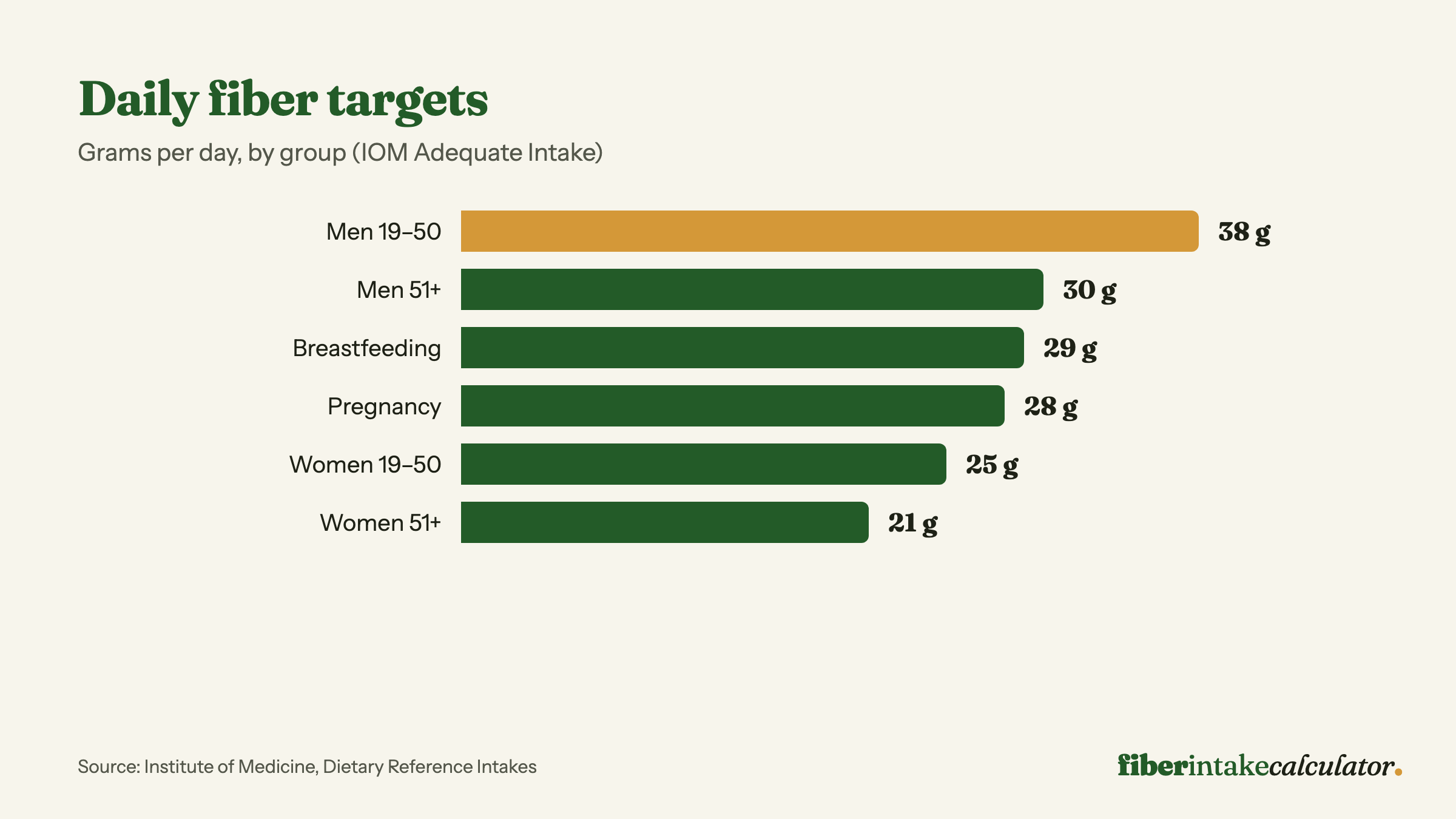
- The age and sex table. The IOM sets an Adequate Intake for each group: 25 grams a day for women aged 19 to 50, 38 grams for men in the same range, with lower targets after 50 and specific values for children, pregnancy, and breastfeeding.
- The energy method: 14 grams per 1,000 calories. This is the formula the IOM used to derive the table in the first place. Fiber needs scale with how much you eat, so if you know your daily calories, this method gives a more personal answer. Someone eating 2,600 kcal a day needs about 36 g of fiber; someone eating 1,600 kcal needs about 22 g.
Both numbers are legitimate. The table is the standard reference; the energy method fits your actual intake. The calculator shows which one produced your result, and the full derivation is on our methodology page.
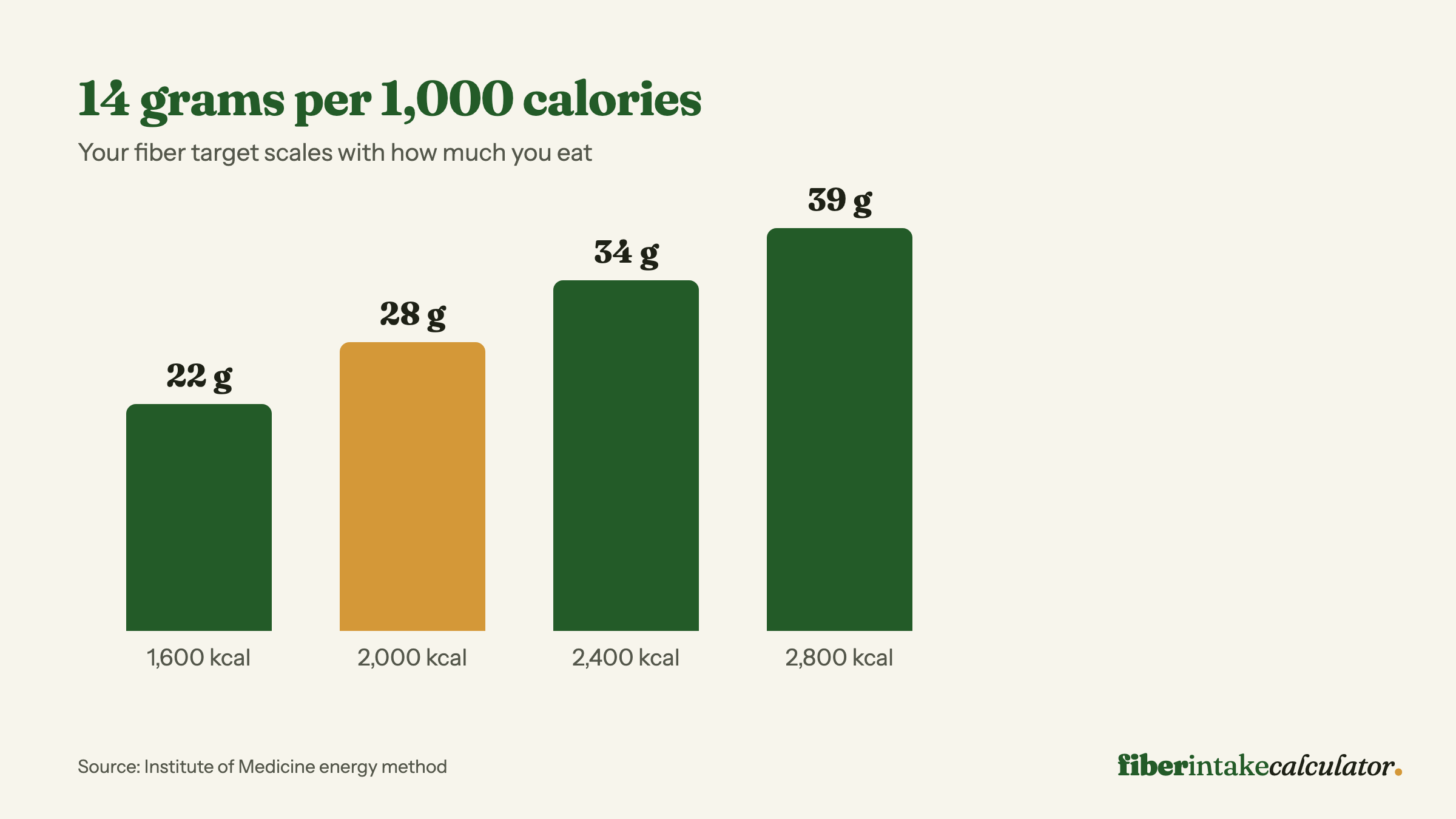
How much fiber per day? The full reference table
| Group | Age | Fiber per day (IOM) |
|---|---|---|
| Children | 1 to 3 | 19 g |
| Children | 4 to 8 | 25 g |
| Girls | 9 to 18 | 26 g |
| Boys | 9 to 13 | 31 g |
| Boys | 14 to 18 | 38 g |
| Women | 19 to 50 | 25 g |
| Women | 51 and older | 21 g |
| Men | 19 to 50 | 38 g |
| Men | 51 and older | 30 g |
| Pregnancy | any age | 28 g |
| Breastfeeding | any age | 29 g |
One number you’ll see elsewhere: food labels use the FDA Daily Value of 28 g, a single reference based on a 2,000-calorie diet. Your personal IOM target can be higher or lower, which is why a label’s “% DV” never quite matches your own math. Both are correct; they answer different questions.
Daily fiber intake for women
Women aged 19 to 50 should aim for 25 grams of fiber per day, dropping to 21 grams after 50 as calorie needs decline. Pregnancy raises the target to 28 grams and breastfeeding to 29 grams. Most American women currently average around 15 grams a day, so the practical gap is about one serving of legumes plus a fruit.
Daily fiber intake for men
Men aged 19 to 50 should aim for 38 grams per day, the highest target of any group, falling to 30 grams after 50. The average American man gets under 19 grams, half the recommendation. Closing a 19-gram gap sounds hard until you see it as food: a cup of lentils (15.6 g) and an apple (4.4 g) do it entirely.
How to actually reach your number
Hitting 25 to 38 grams from food is easier as a structure than as willpower:
- Anchor one meal with legumes. A single cup of cooked lentils, black beans, or split peas delivers 15 to 16 grams, roughly half of most targets. Nothing else on the high-fiber foods chart works this hard.
- Make breakfast do 8 to 10 grams. Oatmeal (4 g per cup) with a tablespoon of chia seeds (5 g) or a cup of raspberries (8 g) gets there without thinking.
- Keep skins on. A medium apple with skin has 4.4 g; peeled it has 2.1 g, so about half the fiber goes in the compost. Same for potatoes and pears. The high-fiber fruits ranking has the peel and juice numbers fruit by fruit.
- Go gradually and drink water. Add 3 to 5 grams every few days. Fiber pulls water into the gut, and jumping from 15 g to 35 g overnight is how people end up bloated and convinced fiber “doesn’t agree with them.”
- Use a supplement only for the last few grams. One labeled dose carries 0.5 to 9 grams depending on the product, so it closes a gap rather than building the base. Our comparison of the best fiber supplements puts every product’s Supplement Facts panel side by side.
If your goal is cholesterol or blood sugar rather than general health, the type matters as much as the total: see the soluble fiber table for the foods with the gel-forming fiber that does that work. Cutting calories? The weight loss variant scales your target to your goal intake.
Why fiber is worth calculating at all
Fiber is the one macronutrient with no digestible calories that still moves major health markers. Higher intakes are consistently associated with lower LDL cholesterol, steadier blood sugar, better regularity, and lower long-term risk of heart disease and colorectal cancer. The catch is that the benefits show up near the recommended intakes, and about 95% of Americans never get there. Knowing your actual number, in grams, is the first fixable step.
Frequently asked questions
How much fiber do I need per day?
Most adults need 21 to 38 grams per day: the IOM recommends 25 g for women and 38 g for men aged 19 to 50, dropping to 21 g and 30 g after 50. The more precise method is 14 g per 1,000 calories you eat, which is what this calculator uses when you enter your calories.
Why does my number differ from the 28 g on food labels?
Food labels use the FDA Daily Value (28 g, based on a 2,000-calorie diet) as a single reference for everyone. Your personal IOM target depends on your age, sex, and calorie intake, so it can be higher or lower than 28 g. Both numbers are shown so you can read labels correctly.
Is this calculator's formula legit?
Yes. It uses the Institute of Medicine (IOM) Adequate Intake values, the same reference behind U.S. dietary guidelines: 14 grams of fiber per 1,000 calories consumed, with age- and sex-specific targets. The full derivation is on our methodology page.
Do you store my inputs?
No. The calculator runs entirely in your browser. Your result is saved only to your own device (so our food tables can show '% of your target') and never reaches our servers.
How do I actually reach my fiber target?
Spread it across meals rather than one sitting: oatmeal or a high-fiber cereal at breakfast, legumes with lunch, fruit and nuts as snacks. Our high-fiber foods chart ranks 80+ foods by fiber per serving. Increase gradually over 2–3 weeks and drink more water to avoid bloating.
Built and maintained by the FiberIntake team, with data from USDA FoodData Central and peer-reviewed sources. Figures are checked against the cited source before publish. About this site →