High-Fiber Fruits, Ranked by Fiber per Serving
Last updated: September 7, 2026
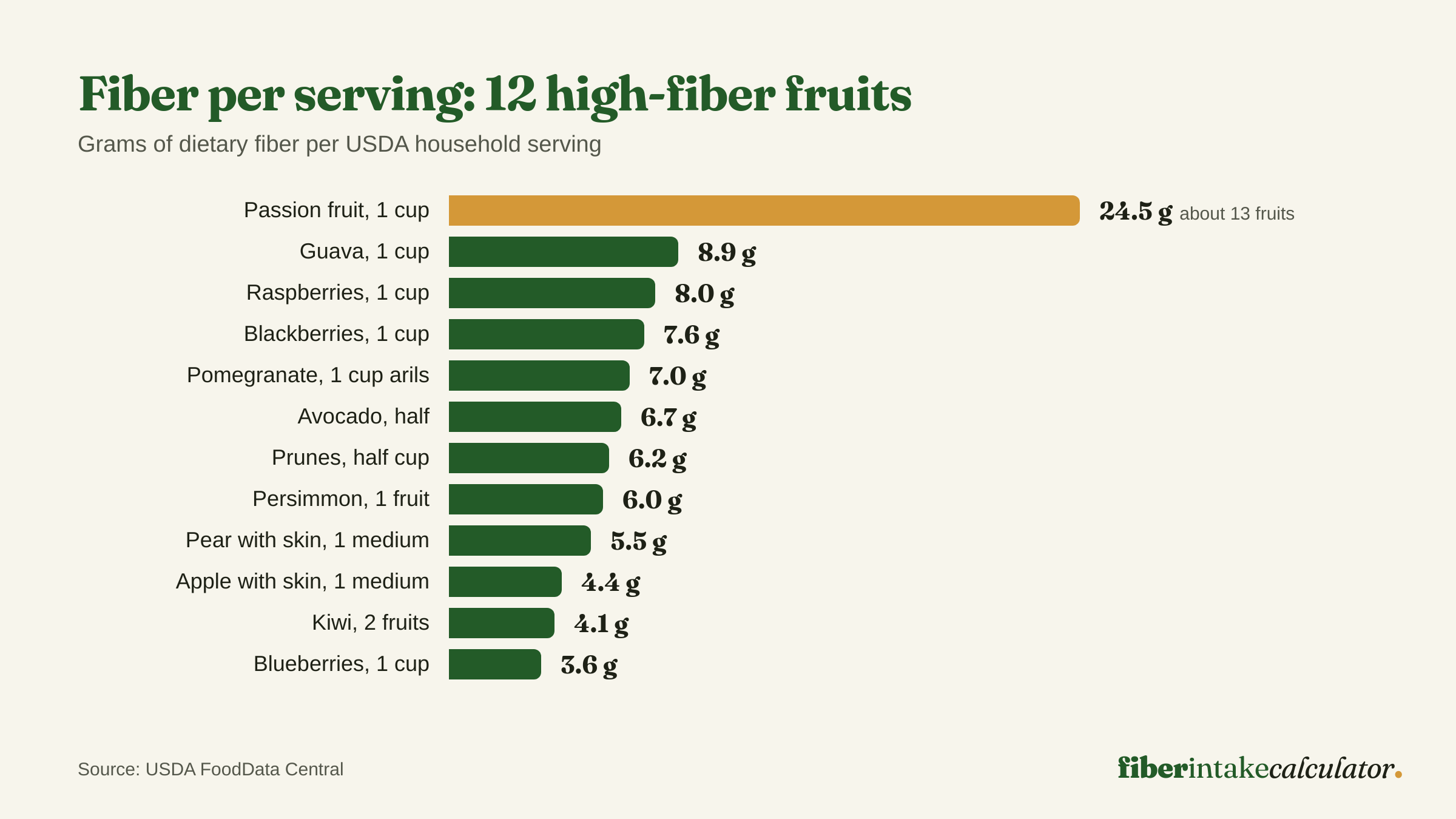
Guava is the highest-fiber fruit you would realistically eat a cup of, at 8.9 grams per cup, followed by raspberries at 8 grams and blackberries at 7.6 grams. Passion fruit tops the raw ranking at 24.5 grams per cup, but that cup is about 13 whole fruits.
Every number here is computed from USDA FoodData Central: fiber measured per 100 grams, multiplied by USDA’s own household serving weight. Nothing is copied from another fiber list, which is why a few values differ from the ones in wide circulation.
The cheapest fiber per calorie is a berry
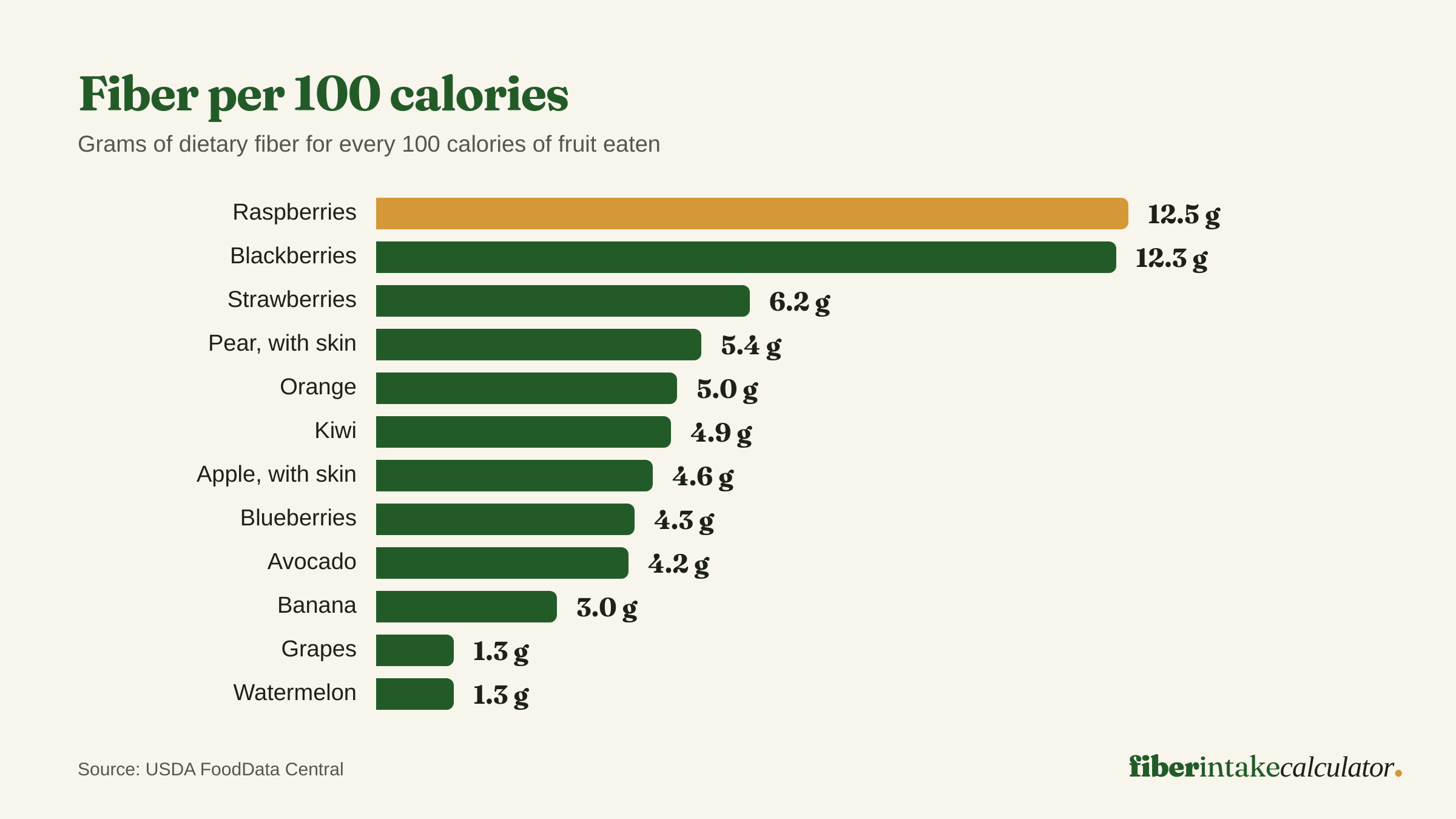
Ranked by serving, berries look ordinary. Ranked per calorie, they are in a different class. Raspberries deliver 12.5 grams of fiber per 100 calories and blackberries 12.3 grams. Grapes and watermelon deliver 1.3 grams.
That is close to a tenfold spread inside one food group. Dried fruit sits near the bottom for the same reason: two Medjool dates carry 3.2 grams of fiber and 133 calories, which works out to 2.4 grams per 100 calories.
Rule of thumb. Eating on a calorie budget, buy berries. Eating normally, the per-serving column is the one that matters, and a pear or half an avocado does more work per item than a cup of strawberries.
That ranking is also what drives our page on how much fiber to eat while losing weight, where the target itself scales down with your calories.
Peeling an apple throws away half its fiber
USDA measures apples both ways. With the skin on, an apple carries 2.4 grams of fiber per 100 grams. Peeled, it carries 1.3 grams. That is a 46% loss for the same fruit.
In whole-fruit terms the gap is wider, because the skin has weight of its own. A medium apple with skin (182 g) gives 4.4 grams. A peeled medium apple (161 g) gives 2.1 grams.
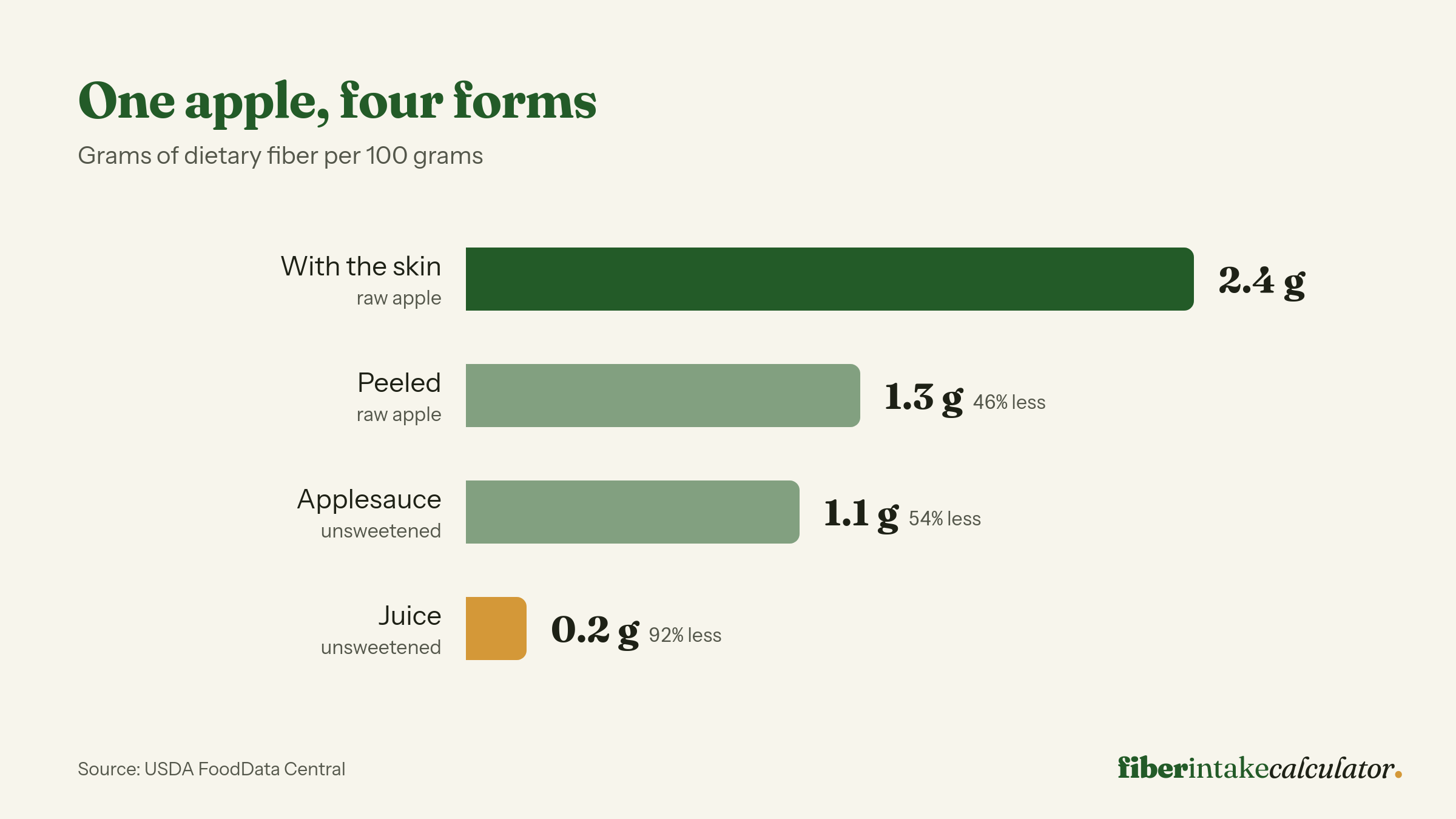
Pears, peaches and nectarines behave the same way. The skin holds most of the insoluble fiber, while the flesh holds the pectin, the soluble fiber that forms a gel and helps with cholesterol. Peeling costs you one of the two.
Apples also show why a single number is never the whole story. USDA’s newer analysis of a medium Fuji apple lands near 3.8 grams against the 4.4 grams of the legacy value used here. Different varieties, different lab methods. Our methodology page explains which figure we use and why.
Juice is the fruit with the fiber taken out
Raw orange juice contains 0.2 grams of fiber per 100 grams, so a cup holds about 0.5 grams. It takes roughly three oranges to fill that cup, and those three oranges would have given you 9.3 grams whole.
Juicing keeps about 5% of the fiber and pours the rest away. The pattern repeats across the aisle:
| Whole fruit | Fiber | The drink or purée | Fiber |
|---|---|---|---|
| 3 oranges (393 g) | 9.3 g | Raw orange juice, 1 cup | 0.5 g |
| Apple with skin, 1 medium | 4.4 g | Unsweetened apple juice, 1 cup | 0.5 g |
| Apple with skin, 1 medium | 4.4 g | Unsweetened applesauce, 1 cup | 2.7 g |
| Grapes, 1 cup | 1.4 g | Unsweetened grape juice, 1 cup | 0.5 g |
Applesauce is the honest middle. It keeps the pulp, so it holds 1.1 grams of fiber per 100 grams against the juice’s 0.2 grams. Blending is different again: nothing is removed, so a smoothie keeps the fiber a juicer would strain out.
The one thing to remember. Eat the fruit, skin included where it is edible. Peeling costs you about half. Juicing costs you almost all of it.
Which part of the fruit carries the fiber
Fiber is structural, so it gathers in skin, seeds and membranes rather than in the sweet flesh people are actually after.
Citrus makes that visible. Orange flesh holds 2.4 grams of fiber per 100 grams. A whole orange measured with its peel holds 4.5 grams, nearly double. That is why a teaspoon of zest is worth more than it looks, and why the pith you pick off a segment is the fibrous part.
Berries carry their fiber in seeds and skin, which is most of the fruit by weight, and that is why they win the per-calorie ranking. Melons are mostly water and hold almost none: a cup of diced watermelon gives 0.6 grams.
How far fruit alone actually gets you
Adults need 25 grams a day for women and 38 grams for men aged 19 to 50, per the Institute of Medicine reference intakes. Those fall to 21 and 30 grams after 50. Get your own number from the fiber calculator if you do not have one yet.
Three generous fruit servings get you partway:
| A day of fruit | Fiber |
|---|---|
| Raspberries, 1 cup | 8.0 g |
| Pear with skin, 1 medium | 5.5 g |
| Apple with skin, 1 medium | 4.4 g |
| Total | 17.9 g |
That is 72% of a 25 gram target and 47% of a 38 gram one, from three servings that already exceed what most people eat in a day.
One cup of cooked lentils adds 15.6 grams by itself. That comparison is the argument of the full high-fiber foods chart: fruit is the easy part of the day, and legumes are what close the gap. A jar closes even less of it, as the numbers in our fiber supplement comparison show.
Every fruit, ranked by fiber per serving
Sort by any column. The fourth is the one most fruit lists leave out: grams of fiber per 100 calories, which tells you what a fruit costs you to eat. The % of your target column uses the result you saved in the calculator, or the FDA Daily Value of 28 g until you have one. Every figure traces to USDA FoodData Central or to the Institute of Medicine intakes, both listed on our sources page.
| Fruit | Fiber per serving (g) | Serving | Fiber per 100 calories (g) | % of your target |
|---|---|---|---|---|
| Passion fruit | 24.5 | 1 cup (236 g) | 10.7 | – |
| Guava | 8.9 | 1 cup (165 g) | 7.9 | – |
| Raspberries | 8 | 1 cup (123 g) | 12.5 | – |
| Blackberries | 7.6 | 1 cup (144 g) | 12.3 | – |
| Pomegranate arils | 7 | 1 cup (174 g) | 4.8 | – |
| Avocado | 6.7 | half (100 g) | 4.2 | – |
| Prunes | 6.2 | half cup pitted (87 g) | 3 | – |
| Persimmon, Japanese | 6 | 1 fruit (168 g) | 5.1 | – |
| Pear, with skin | 5.5 | 1 medium (178 g) | 5.4 | – |
| Apple, with skin | 4.4 | 1 medium (182 g) | 4.6 | – |
| Kiwi, green | 4.1 | 2 fruits (138 g) | 4.9 | – |
| Blueberries | 3.6 | 1 cup (148 g) | 4.3 | – |
| Dates, Medjool | 3.2 | 2 dates (48 g) | 2.4 | – |
| Cherries, sweet | 3.2 | 1 cup pitted (154 g) | 3.3 | – |
| Orange | 3.1 | 1 medium (131 g) | 5 | – |
| Banana | 3.1 | 1 medium (118 g) | 3 | – |
| Strawberries | 3 | 1 cup halves (152 g) | 6.2 | – |
| Figs, fresh | 2.9 | 2 medium (100 g) | 3.9 | – |
| Mango | 2.6 | 1 cup pieces (165 g) | 2.6 | – |
| Papaya | 2.5 | 1 cup pieces (145 g) | 4 | – |
| Nectarine | 2.4 | 1 medium (142 g) | 3.8 | – |
| Peach, with skin | 2.3 | 1 medium (150 g) | 3.9 | – |
| Pineapple | 2.3 | 1 cup chunks (165 g) | 2.8 | – |
| Apricots | 2.1 | 3 apricots (105 g) | 4.2 | – |
| Apple, peeled (for comparison) | 2.1 | 1 medium (161 g) | 2.7 | – |
| Grapefruit, pink | 2 | half fruit (123 g) | 3.9 | – |
| Cantaloupe | 1.4 | 1 cup cubes (160 g) | 2.6 | – |
| Grapes | 1.4 | 1 cup (151 g) | 1.3 | – |
| Watermelon | 0.6 | 1 cup diced (152 g) | 1.3 | – |
Fiber per serving is USDA FoodData Central's per-100-gram value multiplied by USDA's own household serving weight, read September 2026. The per-100-calorie column uses the same records. See the methodology page for how figures are sourced and refreshed.
Frequently asked questions
What fruit has the most fiber?
Per cup, passion fruit at 24.5 grams, but that cup is about 13 whole fruits and one passion fruit gives 1.9 grams. Among fruits you would eat a cup of in one sitting, guava leads at 8.9 grams, then raspberries at 8 grams and blackberries at 7.6 grams. Per whole fruit, half an avocado gives 6.7 grams and a medium pear with the skin gives 5.5 grams.
Do you lose fiber when you peel fruit?
Yes, and it is measurable. USDA lists apples with skin at 2.4 grams of fiber per 100 grams and peeled apples at 1.3 grams, a 46% loss. In whole fruit terms, a medium apple goes from 4.4 grams to 2.1 grams once the skin is off. Pears, peaches and nectarines follow the same pattern, because the skin carries most of the insoluble fiber.
Does fruit juice count toward your fiber intake?
Barely. Raw orange juice holds 0.2 grams of fiber per 100 grams, so a cup contains about 0.5 grams. The three oranges it takes to fill that cup would have given you 9.3 grams whole, so juicing discards roughly 95% of the fiber. Unsweetened applesauce is the better compromise at 2.7 grams per cup.
Which fruits give the most fiber for the fewest calories?
Berries. Raspberries carry 12.5 grams of fiber per 100 calories and blackberries 12.3 grams, several times the 1.3 grams in grapes or watermelon. Sort the chart by the per-100-calorie column to see the full order, which is the useful view when you are eating on a calorie budget.
Can I hit my daily fiber target with fruit alone?
It is possible but impractical. Three generous servings, a cup of raspberries plus a pear plus an apple, come to 17.9 grams, which is 72% of a 25 gram target and 47% of a 38 gram one. A single cup of cooked lentils adds 15.6 grams on its own, so most people reach their number faster by pairing fruit with legumes and whole grains.
Built and maintained by the FiberIntake team, with data from USDA FoodData Central and peer-reviewed sources. Figures are checked against the cited source before publish. About this site →